It was so terribly cold. Snow was falling, and it was almost dark. Evening came on, the last evening of the year. In the cold and gloom a poor little girl, bareheaded and barefoot, was walking through the streets. Of course when she had left her house she'd had slippers on, but what good had they been? They were very big slippers, way too big for her, for they belonged to her mother. The little girl had lost them running across the road, where two carriages had rattled by terribly fast. One slipper she'd not been able to find again, and a boy had run off with the other, saying he could use it very well as a cradle some day when he had children of his own. And so the little girl walked on her naked feet, which were quite red and blue with the cold. In an old apron she carried several packages of matches, and she held a box of them in her hand. No one had bought any from her all day long, and no one had given her a cent.
Shivering with cold and hunger, she crept along, a picture of misery, poor little girl! The snowflakes fell on her long fair hair, which hung in pretty curls over her neck. In all the windows lights were shining, and there was a wonderful smell of roast goose, for it was New Year's eve. Yes, she thought of that!
In a corner formed by two houses, one of which projected farther out into the street than the other, she sat down and drew up her little feet under her. She was getting colder and colder, but did not dare to go home, for she had sold no matches, nor earned a single cent, and her father would surely beat her. Besides, it was cold at home, for they had nothing over them but a roof through which the wind whistled even though the biggest cracks had been stuffed with straw and rags.
Her hands were almost dead with cold. Oh, how much one little match might warm her! If she could only take one from the box and rub it against the wall and warm her hands. She drew one out. R-r-ratch! How it sputtered and burned! It made a warm, bright flame, like a little candle, as she held her hands over it; but it gave a strange light! It really seemed to the little girl as if she were sitting before a great iron stove with shining brass knobs and a brass cover. How wonderfully the fire burned! How comfortable it was! The youngster stretched out her feet to warm them too; then the little flame went out, the stove vanished, and she had only the remains of the burnt match in her hand.
She struck another match against the wall. It burned brightly, and when the light fell upon the wall it became transparent like a thin veil, and she could see through it into a room. On the table a snow-white cloth was spread, and on it stood a shining dinner service. The roast goose steamed gloriously, stuffed with apples and prunes. And what was still better, the goose jumped down from the dish and waddled along the floor with a knife and fork in its breast, right over to the little girl. Then the match went out, and she could see only the thick, cold wall. She lighted another match. Then she was sitting under the most beautiful Christmas tree. It was much larger and much more beautiful than the one she had seen last Christmas through the glass door at the rich merchant's home. Thousands of candles burned on the green branches, and colored pictures like those in the printshops looked down at her. The little girl reached both her hands toward them. Then the match went out. But the Christmas lights mounted higher. She saw them now as bright stars in the sky. One of them fell down, forming a long line of fire.
"Now someone is dying," thought the little girl, for her old grandmother, the only person who had loved her, and who was now dead, had told her that when a star fell down a soul went up to God.
She rubbed another match against the wall. It became bright again, and in the glow the old grandmother stood clear and shining, kind and lovely.
"Grandmother!" cried the child. "Oh, take me with you! I know you will disappear when the match is burned out. You will vanish like the warm stove, the wonderful roast goose and the beautiful big Christmas tree!"
And she quickly struck the whole bundle of matches, for she wished to keep her grandmother with her. And the matches burned with such a glow that it became brighter than daylight. Grandmother had never been so grand and beautiful. She took the little girl in her arms, and both of them flew in brightness and joy above the earth, very, very high, and up there was neither cold, nor hunger, nor fear-they were with God.
But in the corner, leaning against the wall, sat the little girl with red cheeks and smiling mouth, frozen to death on the last evening of the old year. The New Year's sun rose upon a little pathetic figure. The child sat there, stiff and cold, holding the matches, of which one bundle was almost burned.
"She wanted to warm herself," the people said. No one imagined what beautiful things she had seen, and how happily she had gone with her old grandmother into the bright New Year.
Cô bé bán diêm
Rét dữ dội. Tuyết rơi. Trời đã tối hẳn. Đêm nay là đêm giao thừa.
Giữa trời đông giá rét, một em gái nhỏ đầu trần, chân đi đất, đang dò dẫm trong đêm tối.
Lúc ra khỏi nhà em có đi giày vải, nhưng giày vải phỏng có tác dụng gì kia chứ !
Giày ấy của mẹ em để lại, rộng quá, em đã liên tiếp làm văng mất cả hai chiếc khi em chạy qua đường, vào lúc hai chiếc xe ngựa đang phóng nước đại.
Chiếc thứ nhất bị xe song mã nghiến, rồi dính theo tuyết vào bánh xe; thế là mất hút. Còn chiếc thứ hai, một thằng bé lượm được, cười sằng sặc, đem tung lên trời. Nó còn nói với em bé rằng nó sẽ giữ chiếc giày để làm nôi cho con chó sau này.
Thế là em phải đi đất, chân em đỏ ửng lên, rồi tím bầm lại vì rét.
Chiếc tạp dề cũ kỹ của em đựng đầy diêm và tay em còn cầm thêm một bao.
Em cố kiếm một nơi có nhiều người qua lại. Nhưng trời rét quá, khách qua đường đều rảo bước rất nhanh, chẳng ai đoái hoài đến lời chào hàng của em.
Suốt ngày em chẳng bán được gì cả và chẳng ai bố thí cho em chút đỉnh. Em bé đáng thương, bụng đói cật rét, vẫn lang thang trên đường. Bông tuyết bám đầy trên mái tóc dài xõa thành từng búp trên lưng em, em cũng không để ý.
Cửa sổ mọi nhà đều sáng rực ánh đèn và trong phố sực nức mùi ngỗng quay. Chả là đêm giao thừa mà ! Em tưởng nhớ lại năm xưa, khi bà nội hiền hậu của em còn sống, em cũng được đón giao thừa ở nhà. Nhưng thần chết đã đến cướp bà em đi mất, gia sản tiêu tán và gia đình em đã phải lìa ngôi nhà xinh xắn có dây trường xuân leo quanh, nơi em đã sống những ngày đầm ấm, để đến chui rúc trong một xó tối tăm, luôn luôn nghe những lời mắc nhiếc, chửi rủa.
Em ngồi nép trong một góc tường, giữa hai ngôi nhà, một cái xây lùi lại một chút.
Em thu đôi chân vào người, nhưng mỗi lúc em càng thấy rét buốt hơn.
Tuy nhiên em không thể nào về nhà nếu không bán được ít bao diêm, hay không ai bố thí cho một đồng xu nào đem về; nhất định là cha em sẽ đánh em.
Vả lại ở nhà cũng rét thế thôi. Cha con em ở trên gác, sát mái nhà và, mặc dầu đã nhét giẻ rách vào các kẽ hở trên vách, gió vẫn thổi rít vào trong nhà. Lúc này đôi bàn tay em đã cứng đờ ra.
Chà ! Giá quẹt một que diêm lên mà sưởi cho đỡ rét một chút nhỉ ? Giá em có thể rút một que diêm ra quẹt vào tường mà hơ ngón tay nhỉ ? Cuối cùng em đánh liều quẹt một que diêm. Diêm bén lửa thật là nhạy. Ngọn lửa lúc đầu xanh lam, dần dần biếc đi, trắng ra, rực hồng lên quanh que gỗ, sáng chói trông đến vui mắt.
Em hơ đôi tay trên que diêm sáng rực như than hồng. Chà ! Ánh sáng kỳ diệu làm sao ! Em tưởng chừng như đang ngồi trước một lò sưởi bằng sắt có những hình nổi bằng đồng bóng nhoáng. Trong lò, lửa cháy nom đến vui mắt và tỏa ra hơi nóng dịu dàng.
Thật là dễ chịu ! Đôi bàn tay em hơ trên ngọn lửa; bên tay cầm diêm, cái ngón cái nóng bỏng lên. Chà ! Khi tuyết phủ kín mặt đất, gió bấc thổi vun vút mà được ngồi hàng giờ như thế, trong đêm đông rét buốt, trước một lò sưởi, thì khoái biết bao!
Em vừa duỗi chân ra sưởi thì lửa vụt tắt, lò sưởi biến mất. Em ngồi đó, tay cầm que diêm đã tàn hẳn. Em bần thần cả người và chợt nghĩ ra rằng cha em đã giao cho em đi bán diêm; đêm nay, về nhà thế nào cũng bị cha mắng.
Em quẹt que diêm thứ hai, diêm cháy và sáng rực lên. Bức tường như biến thành một tấm rèm bằng vải màn. Em nhìn thấu tận trong nhà. Bàn ăn đã dọn, khăn trải trắng tinh, trên bàn bày toàn bát đĩa bằng sứ quý giá, và có cả một con ngỗng quay. Nhưng điều kỳ diệu nhất là ngỗng ta nhảy ra khỏi dĩa và mang cả dao ăn, phóng sết, cắm trên lưng, tiến về phía em bé.
Rồi... que diêm vụt tắt; trước mặt em chỉ còn là những bức tường dầy đặc và lạnh lẽo.
Thực tế đã thay thế cho mộng mị: chẳng có bàn ăn thịnh soạn nào cả, mà chỉ có phố xá vắng teo, lạnh buốt, tuyết phủ trắng xoá, gió bấc vi vu và mất ngừơi khách qua đường quần áo ấm áp vội vã đi đến những nơi hẹn hò, hoàn toàn lãnh đạm với cảnh nghèo khổ của em bé bán diêm.
Em quẹt que diêm thứ ba. Bỗng em thấy hiện ra một cây thông Noel. Cây này lớn và trang trí lộng lẫy hơn cây mà em đã được thấy năm ngoái qua cửa kính một nhà buôn giàu có. Hàng ngàn ngọn nến sáng rực, lấp lánh trên cành lá xanh tươi và rất nhiều bức tranh màu sắc rực rỡ như những bức bày trong các tủ hàng, hiện ra trước mắt em bé. Em với đôi tay về phía cây... nhưng diêm tắt. Tất cả những ngọn nến bay lên, bay lên mãi rồi biến thành những ngôi sao trên trời.
- Chắc hẳn có ai vừa chết, em bé tự nhủ, vì bà em, người hiền hậu độc nhất đối với em, đã chết từ lâu, trước đây thường nói rằng: "Khi có một vì sao đổi ngôi là có một linh hồn bay lên trời với thượng đế".
Em quẹt một que diêm nữa vào tường, một ánh sáng xanh tỏa ra xung quanh và em bé nhìn thấy rõ ràng là bà em đang mỉm cười với em.
- Bà ơi ! Em bé reo lên, cho cháu đi với ! Cháu biết rằng diêm tắt thì bà cũng biến đi mất như lò sưởi, ngỗng quay và cây Noel ban nãy, nhưng xin bà đừng bỏ cháu ở nơi này; trước kia, khi bà chưa về với thượng đế chí nhân, bà cháu ta đã từng sung sướng biết bao ! Dạo ấy bà đã từng nhủ cháu rằng nếu cháu ngoan ngoãn cháu sẽ được gặp lại bà; bà ơi! cháu van bà, bà xin với Thượng Đế chí nhân cho cháu về với bà. Chắc Người không từ chối đâu.
Que diêm tắt phụt và ảo ảnh rực sáng trên khuôn mặt em bé cũng biết mất.
Thế là em quẹt tất cả những que diêm còn lại trong bao. Em muốn níu bà em lại ! Diêm nối nhau chiếu sáng như giữa ban ngày. Chưa bao giờ em thấy bà em to lớn và đẹp lão như thế này. Bà cụ cầm lấy tay em, rồi hai bà cháu bay vụt lên cao, cao mãi, chẳng còn đói rét, đau buồn nào đe dọa họ nữa. Họ đã về với Thuợng đế.
Sáng hôm sau, tuyết vẫn phủ kín mặt đất, nhưng mặt trời lên, trong sáng, chói chang trên bầu trời xanh nhợt. Mọi người vui vẻ ra khỏi nhà.
Trong buổi sáng lạnh lẽo ấy, ở một xó tường người ta thấy một em gái có đôi má hồng và đôi môi đang mỉm cười. Em đã chết vì giá rét trong đêm giao thừa.
Ngày mồng một đầu năm hiện lên trên tử thi em bé ngồi giữa những bao diêm, trong đó có một bao đã đốt hết nhẵn. Mọi người bảo nhau: "Chắc nó muốn sưởi cho ấm!." Nhưng chẳng ai biết những cái kỳ diệu em đã trông thấy, nhất là cảnh huy hoàng lúc hai bà cháu bay lên để đón lấy những niềm vui đầu năm.
I'm Susan Clark with WORDS AND THEIR STORIES, a program in Special English on the Voice of America.
People often say that money talks. They mean that a person with a lot of money can say how he or she wants things done. But it is not easy to earn enough money to gain this kind of power.
Ask anyone in a business. They will tell you that it is a jungle out there. The expression probably began because the jungle is filled with wild animals and unknown dangers that threaten people. Sometimes people in business feel competing businesses are as dangerous as wild animals. And they feel that unknown dangers in the business world threaten the survival of their business.
People in business have to be careful if they are to survive the jungle out there. They must not be led into making bogus investments. Bogus means something that is not real.
*Dictionary online* You just type new words and see their meaning.
Nobody is sure how the word got started. But it began to appear in American newspapers in the eighteen hundreds. A newspaper in Boston, Massachusetts said the word came from a criminal whose name was Borghese. The newspaper said Borghese wrote checks to people although he did not have enough money in the bank. After he wrote the checks, he would flee from town. So, people who were paid with his checks received nothing. The newspaper said Americans shortened and changed the criminal's name Borghese, to bogus.
People trying to earn money also must be aware of being ripped off. A person who is ripped off has had something stolen, or at least has been treated very unfairly.
A writer for the magazine "American Speech" said he first saw the expression used in nineteen seventy-one. It was on a sign that a student carried during a protest demonstration at a university. The message on the sign was that the student felt ripped off, or cheated.
Perhaps the best way to prevent getting ripped off in business is to not try to get rich quickly. To be successful, a person in business works hard and tries to get down to brass tacks.
This expression means to get to the bottom or most important part of something. For example, a salesman may talk and talk about his product without saying the price. You get down to brass tacks when you say, "it sounds good, but how much does it cost?"
Word expert Charles Funk thinks the expression comes from sailors on ships. They clean the bottom of a boat. When they have removed all the dirt, they are down to the brass tacks, the copper pieces that hold the boat together.
So, if we get down to brass tacks, we can prevent ripoffs and bogus ways of earning money in that jungle out there. And, some good luck will help, too.
(MUSIC)
This WORDS AND THEIR STORIES was written by Jeri Watson. I'm Susan Clark
Now, the VOA Special English program WORDS AND THEIR STORIES.
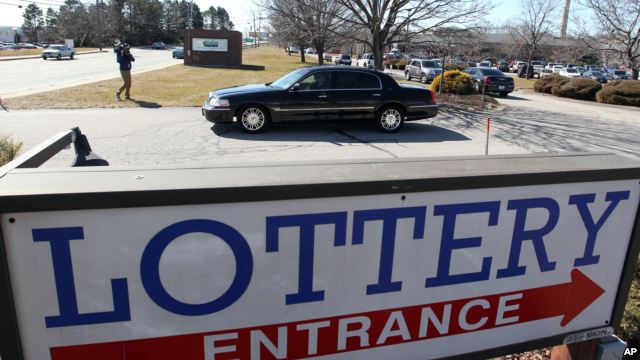
A lottery winner leaves the Rhode Island Lottery headquarters in a limousine after being presented a check for $336.4 million
Most people enjoy working for several reasons. Their job might be fun, or they like their employer and the other people at work. Most people I know, however, work for the money. I do not know anyone who is loaded, or extremely rich. Most of my friends work to earn enough money to live. They have to make ends meet. They have to earn enough money to pay for the things they need. Some even live from hand to mouth. They only have enough money for the most important things.
*Dictionary online* You just type new words and see their meaning.
They struggle to earn enough money to bring home the bacon. It can be difficult to earn enough money for a family to survive. Sometimes, poor people even get caught short. They do not have enough money to pay for what they need.
Or they have to spend or lay out more money than they want for something. When this happens, poor people have to tighten their belts and live on less money than usual. I hate when I have to live on less money. It takes me longer to get back on my feet, or return to good financial health.
However, other people are on the gravy train. They get paid more money than their job is worth. These people make a bundle. They really rake in the cash. In fact, they make so much money that they can live high off the hog. They own the best of everything and live in great ease. Sometimes they pay an arm and a leg for something.
Because money is no object to wealthy people, they will pay high prices for whatever they want. Sometimes, they even pay through the nose. They pay too much for things.
I am not rich. I did not make a killing in the stock market when my stocks increased in value. Yet, I am not poor either. When I go out with friends, I do not want to shell out or pay a lot of money. Often, my friends and I will chip in or pay jointly for a fun night out. When we go to restaurants the meal is Dutch treat. Each person pays his or her own share.
Once, the owner of a restaurant gave us a dinner on the house. We did not have to pay for our meals. However, I admit that we had to grease someone’s palm. We had to pay money to the employee who led us to our table. The money was for a special request. Yes, it was a buy off. The employee put us at the top of the list for a table instead of making us wait like everyone else. We had a great time that night and the meal did not set me back at all. I did not have to pay anything.
Because of that experience, I will always remember that nice things still happen in a world that is driven by money. But, that is just my two cents worth. It is just my opinion.
(MUSIC)
WORDS AND THEIR STORIES, in VOA Special English, was written by Jill Moss. I’m Faith Lapidus.
Now, the VOA Special English program WORDS AND THEIR STORIES.
Printing Produces Millions of Dollars a Day
Many people believe that money makes the world go around. Others believe that money buys happiness. I do not agree with either idea. But I do admit that money can make people do strange things. Let me tell you about a person I once knew who liked to play card games for money. He liked to gamble.
My friend Bob had a problem because he liked to gamble at all costs. He would play at any time and at any price. To take part in a card game such as poker, my friend would have to ante up. He would have to pay a small amount of money at the beginning of the game.
*Dictionary online* You just type new words and see their meaning.
Bob always played with cold, hard cash --only coins and dollar bills. Sometimes my friend would clean up. He would win a lot of money on one card game. He liked to tell me that one day he would break the bank. What a feeling it must be to win all of the money at a gambling table!
Other times my friend would simply break even. He neither won nor lost money. But sometimes Bob would lose his shirt. He would lose all the money he had. He took a beating at the gambling table. When this happened, my friend would have to go in the hole. He would go into debt and owe people money.
Recently, Bob turned to crime after losing all his money. In his job, he kept the books for a small business. He supervised the records of money earned and spent by the company. Although my friend was usually honest, he decided to cook the books. He illegally changed the financial records of the company. This permitted him to make a fast buck. My friend made some quick, easy money dishonestly.
I never thought Bob would have sticky fingers. He did not seem like a thief who would steal money. But, some people will do anything for love of money.
Bob used the money he stole from his company to gamble again. This time, he cashed in. He made a lot of money. Quickly he was back on his feet. He had returned to good financial health. His company, however, ended up in the red. It lost more money than it earned. The company was no longer profitable.
It did not take long before my friend’s dishonesty was discovered. The company investigated and charged him with stealing. Bob tried to pass the buck. He tried to blame someone else for the deficit. His lie did not work, however. He ended up in jail. Today, I would bet my bottom dollar that my friend will never gamble again. I would bet all I have that he learned his lesson about gambling.
(MUSIC)
WORDS AND THEIR STORIES, in VOA Special English, was written by Jill Moss. I’m Faith Lapidus.
Now, the VOA Special English program WORDS AND THEIR STORIES.
Twenty Powerball Winners in Iowa will split a $241 million lottery windfall they won earlier this month
I think people everywhere dream about having lots of money. I know I do. I would give anything to make money hand over fist. I would like to earn large amounts of money. You could win a large amount of money in the United States through lotteries. People pay money for tickets with numbers. If your combination of numbers is chosen, you win a huge amount of money – often in the millions. Winning the lottery is a windfall.
*Dictionary online* You just type new words and see their meaning.
A few years ago, my friend Al won the lottery. It changed his life. He did not have a rich family. He was not born with a silver spoon in his mouth. Instead, my friend was always hard up for cash. He did not have much money. And the money he did earn was chicken feed – very little.
Sometimes Al even had to accept hand-outs, gifts from his family and friends. But do not get me wrong. My friend was not a deadbeat. He was not the kind of person who never paid the money he owed. He simply pinched pennies. He was always very careful with the money he spent. In fact, he was often a cheapskate. He did not like to spend money. The worst times were when he was flat broke and had no money at all.
One day, Al scraped together a few dollars for a lottery ticket. He thought he would never strike it rich or gain lots of money unexpectedly. But his combination of numbers was chosen and he won the lottery. He hit the jackpot. He won a great deal of money.
Al was so excited. The first thing he did was buy a costly new car. He splurged on the one thing that he normally would not buy. Then he started spending money on unnecessary things. He started to waste it. It was like he had money to burn. He had more money than he needed and it was burning a hole in his pocket so he spent it quickly.
When we got together for a meal at a restaurant, Al paid every time. He would always foot the bill, and pick up the tab. He told me the money made him feel like a million dollars. He was very happy.
But, Al spent too much money. Soon my friend was down and out again. He had no money left. He was back to being strapped for cash. He had spent his bottom dollar, his very last amount. He did not even build up a nest egg. He had not saved any of the money.
I admit I do feel sorry for my friend. He had enough money to live like a king. Instead, he is back to living on a shoestring -- a very low budget. Some might say he is penny wise and pound foolish. He was wise about small things, but not about important things.
(MUSIC)
WORDS AND THEIR STORIES, in VOA Special English, was written by Jill Moss. I’m Faith Lapidus.